I'll be the first to admit these two truths: I love to eat good food and I love to read about eating good food. No one writes about good food--it history, and how to find it, cook it, and eat it--better than Michael Pollan. This past week, while on a road trip to a library conference, I finished listening to Pollan's In Defense of Food: An Eater's Manifesto on audio book.
Readers may be more familiar with his The Omnivore's Dilemma: A Natural History of Four Meals, or more recently his book turned PBS documentary, The Botany of Desire: A Plant's-Eye View of the World. Similar to these two works, In Defense of Food examines food from social, cultural and scientific perspectives. But more specifically, in this, Pollan presents a fascinating analysis of the American diet: how we eat, and how and why our eating habits have changed since the mid-20th century. He balances this history by presenting a series of "rules" for eating (which he's recently condensed into his book Food Rules: An Eater's Manual). Things like,"Eat food. Not too much. Mostly plants"--the line with which he opens. To the more humorous, "Don't eat anything your grandmother wouldn't recognize as food." It's all fairly common sense stuff--but utterly fascinating. If nothing else, readers of Pollan's work will become more cognizant of the food they eat. Devotees (like me) will find themselves taking a more action-oriented approach: reading labels, planting a garden, shopping locally, eating organic, and spreading the word. Highly recommended.
Sunday, April 25, 2010
Sunday, April 11, 2010
Life On the Farm
Admittedly, I had one primary worry about our last Adult Book Club selection, Michael Perry's memoir Coop: A Year Of Poultry, Pigs and Parenting--namely, that people might not make it past the first chapter. (I know of at least one individual who gave up before its end!) Perry opens with a (pages long) description of the "farmer snort" method of blowing one's nose. I'm not entirely sure why he chooses to begin in this way. And I can see where it would be over-the-top for some readers, if not off-putting. But those who spend a little patience on him as he develops his narrative will be rewarded in the end.
At heart, Coop is a story about farms and families. Perry's memoir moves back and forth between his current life with wife Anneliese, as they raise daughters Amy and new baby Jane, and his own life growing up on a farm. My favorite section is undoubtedly Chapter 5 which describes the at-home birth of Jane. Perry's recounting is touching, beautiful, vivid, inspiring. But my overall impression of the work always comes back to Perry and his relationship with daughter, Amy. Amy is present in nearly everything Perry experiences, and its her presence and free-spirit which gives awareness and meaning to the very simple pleasures of farm life which he describes. Perry is nostalgic in these moments, but with the mark of a great writer, he never over-sentimentalizes. A good read for anyone who's ever lived on a farm, raised a family or just has a natural curiosity.
Wednesday, April 7, 2010
Gleeful for Glee
If there's one television show this season that I can't get enough of it's FOX's new hit, Glee. Glee is the continuing story of a high school glee club, its members and the adults (in this case, a group of teachers and coaches) who anchor the whole thing. In many ways, the show models other teen stories: the central group of students are talented misfits who no one has much faith in, and yet, who continue to prove everyone wrong. But that's not really what's worth watching about Glee. The joy of the program comes from the sometimes dark, always quirky characters--the budding superstar and drama queen, Rachel; the overzealous and hilariously cruel cheerleading coach (played by Jane Lynch); the adorably obsessive-compulsive counselor--who would all drive us nuts in real life, but who we love to root for in this setting. And let's not forget what this show is all about: the music. The cast is truly superb: so much so that if you don't find yourself singing along, or at least bouncing your knee or foot, you're very much alone. In fact, if you listen enough, you may find yourself forgetting the originals of the many popular songs the cast covers. For example, in the last episode of Part I of this season, the lead role of Rachel, played by Lea Michele, "out Barbara Streisands Barbara Streisand" (to quote a friend of mine) in her version of "Don't Rain On My Parade" from Funny Girl. That alone is something to see.
Part II of Glee begins next week on FOX. In the meantime, check out Part I on DVD, or either of the two tv soundtracks, at your local library. You'll be oh so happy you did.
Monday, March 22, 2010
THE HELP IS WORTH THE WAIT
If you've heard of first time novelist Kathryn Stockett's book The Help, then you also likley know that it's been hugely popular among readers. In fact, a patron recalled today searching for a copy of the book in our catalog several days ago: only one copy was available in the whole system. That's one copy out of 107 total copies among 169 public libraries.
Being popular isn't often indicitive of quality. But in this case, Stockett has created a story well deserved of acclaim. The Help is a novel, at large, about race relations in the 1960s South. But it's also a story about relationships between women, class, family ties, oral traditions and the importance of creating our own narratives. It's a fast moving read you won't want to put down. Don't wait to get on your library's wait list.
Monday, February 22, 2010
Departures
No, it's not a book. But it develops with the beauty and subtle awe of a great novel, which is why I feel compelled to discuss it here.
Departures is a Japanese film which won an academy award for Best Foreign Language Film at the 2009 Oscars. It's the story of a young male cellist, Diago, who finds himself out of work when the orchestra he performs with dissolves. As a result, he moves back to his hometown with his wife to the house his mother left him. There, he begins looking for work when he finds an ad for someone to assist with "departures". Diago is uncertain what the job entails, but assumes it must relate to travel. While interviewing, he discovers, however, that "departures" is in reference to death: the job requires Diago to assist in preparing bodies in front of mourners before placing them in a coffin. Not without hesitation, Diago accepts the position, primarily because of the pay.
From that point, we see Diago and his wife struggle with his new role, and we meet endearing members of the community. We also glimpse into Diago's childhood and grow to understand the significance of his being a cellist. What's most fascinating, though, is observing and coming to understand the ceremony of death in Japanese culture. In the film, we repeatedly see Diago clean, dress and make-up the deceased with the grace of playing cello. In turn, we see how the elaborate and intimate process enables family and friends to come to terms with the death of a loved one.
There's much more to this film that my oversimplified summary. The snapshots, sounds, symbols, characters and narrative all work together to create a beautiful work of art. And while Westerners may at first cringe to see the unusual death ceremony played out in film, they will likely grow to appreciate it by the movie's end.
Departures is a Japanese film which won an academy award for Best Foreign Language Film at the 2009 Oscars. It's the story of a young male cellist, Diago, who finds himself out of work when the orchestra he performs with dissolves. As a result, he moves back to his hometown with his wife to the house his mother left him. There, he begins looking for work when he finds an ad for someone to assist with "departures". Diago is uncertain what the job entails, but assumes it must relate to travel. While interviewing, he discovers, however, that "departures" is in reference to death: the job requires Diago to assist in preparing bodies in front of mourners before placing them in a coffin. Not without hesitation, Diago accepts the position, primarily because of the pay.
From that point, we see Diago and his wife struggle with his new role, and we meet endearing members of the community. We also glimpse into Diago's childhood and grow to understand the significance of his being a cellist. What's most fascinating, though, is observing and coming to understand the ceremony of death in Japanese culture. In the film, we repeatedly see Diago clean, dress and make-up the deceased with the grace of playing cello. In turn, we see how the elaborate and intimate process enables family and friends to come to terms with the death of a loved one.
There's much more to this film that my oversimplified summary. The snapshots, sounds, symbols, characters and narrative all work together to create a beautiful work of art. And while Westerners may at first cringe to see the unusual death ceremony played out in film, they will likely grow to appreciate it by the movie's end.
Thursday, February 11, 2010
Kitchen Favs
One of my favorite places to hang out is my kitchen. I love experimenting with new dishes and desserts to the sounds of Diana Krall, Cesaria Evora, Michael Buble or whatever else I might be in the mood for. And because I love to cook, I also love reading and collecting cooking magazines and books.
My favorite day-to-day magazine is Everyday Food--which is also available in TV format on PBS stations. When I have more time, or I'm looking for tips on kitchen tools or the best brand of (say) olive oil, I like Cooks, Illustrated by the authors of America's Test Kitchen (also viewable on PBS).
In terms of books, I've some standards which I rely on: Julia Child's Mastering the Art of French Cooking, The Taste of Home Cookbook, or Nancy Baggett's The All-American Cookie Book. But recently, the publishing world has released some great new cooking and baking books that not only include great recipes, they include engaging stories, and useful kitchen tips. Here are my top 5 new-ish recommendations (in no particular order):
1) The Amish Cook's Baking Book, by Lovina Eicher (2009)
2) The Farm Chicks In the Kitchen, by Teri Edwards & Serena Thompson (2009)
3) Healthy Bread In Five Minutes A Day, by Jeff Hertzberg & Zoe Francois (2009)
4) America's Test Kitchen: The Complete TV Show Cookbook (2009)
5) Love Soup: 160 All-New Vegetarian Recipes from the Author of The Vegetarian Epicure, by Anna Thomas (2009)
To search for or place a hold on one of these items, check out our PrairieCat link (left sidebar). Then, simply type in the book or magazine title, or artist/author and click search. If we don't have the item you're interested in, select select "All Locations" under the Select Locations heading on the right sidebar. To place a hold, select the "Place Hold" icon. You'll need your library card on hand to enter your barcode and pin (usually the last 4 digits of your library card). After you place a hold, the library will call you whenever the item comes in.
Bon appetite!
My favorite day-to-day magazine is Everyday Food--which is also available in TV format on PBS stations. When I have more time, or I'm looking for tips on kitchen tools or the best brand of (say) olive oil, I like Cooks, Illustrated by the authors of America's Test Kitchen (also viewable on PBS).
In terms of books, I've some standards which I rely on: Julia Child's Mastering the Art of French Cooking, The Taste of Home Cookbook, or Nancy Baggett's The All-American Cookie Book. But recently, the publishing world has released some great new cooking and baking books that not only include great recipes, they include engaging stories, and useful kitchen tips. Here are my top 5 new-ish recommendations (in no particular order):
1) The Amish Cook's Baking Book, by Lovina Eicher (2009)
2) The Farm Chicks In the Kitchen, by Teri Edwards & Serena Thompson (2009)
3) Healthy Bread In Five Minutes A Day, by Jeff Hertzberg & Zoe Francois (2009)
4) America's Test Kitchen: The Complete TV Show Cookbook (2009)
5) Love Soup: 160 All-New Vegetarian Recipes from the Author of The Vegetarian Epicure, by Anna Thomas (2009)
To search for or place a hold on one of these items, check out our PrairieCat link (left sidebar). Then, simply type in the book or magazine title, or artist/author and click search. If we don't have the item you're interested in, select select "All Locations" under the Select Locations heading on the right sidebar. To place a hold, select the "Place Hold" icon. You'll need your library card on hand to enter your barcode and pin (usually the last 4 digits of your library card). After you place a hold, the library will call you whenever the item comes in.
Bon appetite!
Tuesday, February 2, 2010
For Political Junkies
I’m not one for gossip. But there was something that drew me to read the gossipy new history of the last Presidential election, Game Change: Obama and the Clintons, McCain and Palin, and the Race of a Lifetime, written by veteran political reporters John Heilemann and Mark Halperin. Perhaps it was the political hype or the unprecedented dynamics of our last election that snagged me . But like the election and all its coverage, I was sunk by the first paragraph, and couldn’t put the thing down thereafter.
If you’ve been doing any reading or television viewing of late, you’re probably familiar with some of the book’s claims of the presidential would-bes. Heilemann and Halperin offer readers an unusually candid and behind-closed-doors look at the candidates and their camps from before the election began, to its notable finish. If you haven’t yet heard some of the claims, you’ve certainly seen the fallout: Senator Reid’s apology for his use of racially insensitive words to describe President Obama; or, Edwards’ acknowledgement of his child with Rielle Hunter. But what’s most fascinating is the otherwise general silence from the book’s subjects. To date, very few of the major players have offered information refuting Heilemann and Halperin’s claims.
The biggest complaint made by politicians and journalists, alike, is the authors’ lack of sources. Despite their solid reputations, the authors’ choice to withhold their sources of information has been nothing short of taboo for journalists of their caliber.
For more particulars, read the NY Times Review or listen to NPR’s Talk of the Nation.
If you’ve been doing any reading or television viewing of late, you’re probably familiar with some of the book’s claims of the presidential would-bes. Heilemann and Halperin offer readers an unusually candid and behind-closed-doors look at the candidates and their camps from before the election began, to its notable finish. If you haven’t yet heard some of the claims, you’ve certainly seen the fallout: Senator Reid’s apology for his use of racially insensitive words to describe President Obama; or, Edwards’ acknowledgement of his child with Rielle Hunter. But what’s most fascinating is the otherwise general silence from the book’s subjects. To date, very few of the major players have offered information refuting Heilemann and Halperin’s claims.
The biggest complaint made by politicians and journalists, alike, is the authors’ lack of sources. Despite their solid reputations, the authors’ choice to withhold their sources of information has been nothing short of taboo for journalists of their caliber.
For more particulars, read the NY Times Review or listen to NPR’s Talk of the Nation.
Sunday, January 24, 2010
Meet Miffy
If you have children or grandchildren, or if you just love children's books like I do, then you must check out Miffy. Miffy is the brainchild of Dutch author and illustrator, Dick Bruna, who developed the character 50 years ago. Bruna has since written over 200 books, nearly 30 of which feature the simple rabbit figure who has gained international popularity with children. Like many popular picturebook characters, Miffy has been turned into an animated television show and her image appears on an array of apparel items.CBS Sunday Morning ran a feature story on Bruna and his Miffy on December 6, 2009.
Sunday, January 17, 2010
Resolve To Read A Great Book In 2010
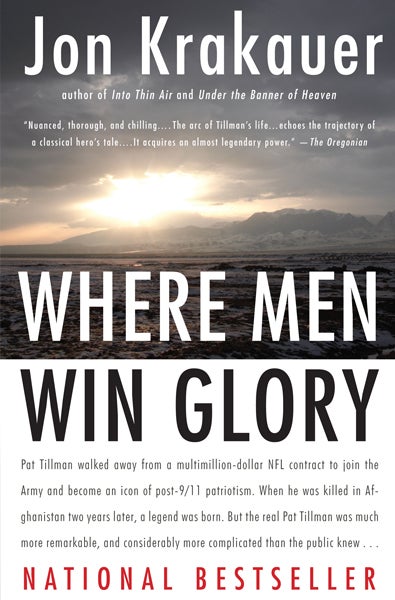
For me, to be defined as “great”, a work of literature must pass one additional litmus test: after reading, I must not forget it. I must consider and re-consider it. I must wrestle with it. If after reading it, I can immediately close the cover and begin another book, then I have not been touched, challenged or provoked. No book better met this definition in 2009 than Jon Krakauer’s epic tale, Where Men Win Glory: The Odyssey of Pat Tillman.
Football fans will likely know the former Arizona Cardinal who left his position as safety to enlist in the Army following the attacks of 9/11. While serving a tour in Afghanistan, Pat Tillman was killed by fratricide (or, “friendly fire”)--a fact deliberately withheld from Tillman’s family, the media and the American public by the United States government. But this summation is only the beginning of Tillman’s journey.
In Where Men Win Glory, author Jon Krakauer presents two tightly interwoven narratives: Tillman’s rise from a loyal, but hot-headed teenager to a rising football star and conflicted soldier, with the rise of a group of Afghanis from anti-Soviet freedom fighters to anti-American terrorists (more commonly known as the Taliban). We see this juxtaposition presented through Krakauer’s tight historical timeline based on first-hand accounts, government reports, journalistic sources, interviews, diaries, journals and letters. Krakauer’s in-depth research demonstrates what it is to be a good journalist.
But, as usual, Krakauer goes beyond the journalistic to create something literary. Readers may recognize Krakauer’s other works, Into the Wild, Under the Banner of Heaven and Into Thin Air (which the Julia Hull District Library book club will be reading in January). All distinct (true) stories, these works share common threads: a male lead, compelled by a sense of duty and adventure, willingly risks his life for some (supposed) larger good.
Where Men Win Glory is no exception to this rule. In it, Krakauer begs three looming questions: Why are humans driven to sacrifice, even in the face of great danger? When should we protect our own interests, and when are we morally obligated to project the interests of our community, nation, world? What is our duty to country and what is our country’s duty to us? Examining Tillman’s tale is central to answering these questions.
Pat Tillman’s story is that of a hero, but not only in the classic sense, which Krakauer alludes to in the title of his work. Rather, Tillman is a recognizable character who commands respect from his family, friends and peers--a man who loves deeply, reads and reflects fervently, questions adamantly and lives fully. Readers will grow to admire the person, beyond the image.
A warning: Krakauer’s account of Tillman’s experiences will at times enrage you; Parts 3 and 4 which describe his death and cover-up should haunt you. But these are the things of great literature: the lump in your throat, the shadow on your memory. Like any New Year’s resolution, these are the things that can change us by altering the way in which we see the world. During a time of year where many resolve to change for the better, challenge yourself this 2010 to read and reflect upon a great book.
Subscribe to:
Posts (Atom)