Tuesday, August 3, 2010

For Enthusiastic Bakers

I recently checked out a new baking book by John Barricelli entitled, The SoNo Baking Company Cookbook: The Best Sweet & Savory Recipes for Every Occasion.  Martha Stewart fans may recognize Barricelli's name from his contributions to her EveryDay Food Magazine and EveryDay Baking TV series on PBS.

Anyone who follows the EveryDay Food line will know that the recipes are deliberately simple, using (mostly) traditional ingredients, and having consistently good taste.  Recipes in Barricelli's new book are no exception.  The Nectarine-Blueberry Buckle (which I made using fresh, local fruit from the farmer's market) is a perfect summer treat; and Barricelli's recipe for traditional white bread brims with buttery goodness just 15 minutes out of the oven.  (Unlike many store-bought breads, his recipe produces a solid bread, which held up well over a high flame when I used it to make grilled panini.)  Bakers and eaters alike will enjoy sampling from this new collection. 

Monday, July 26, 2010

Confessions

I confess:  growing up I wanted Pa (played by Michael Landon) from Little House On the Prairie to be my dad.  Didn't everyone?  He was hardworking, tender, handsome, honorable, and well-respected.   Moreover, I imagined what it would be like to live in that "little house," in Walnut Grove, attending a one-room schoolhouse.  Looking back, it's a little silly.  But like many viewers, I found myself drawn the wholesomeness of it all.   It's this nostalgia which drew me to read Alison Arngram's new book, Confessions Of A Prairie Bitch:  How I Survived Nellie Oleson and Learned to Love Being Hated.  It is, of course, an autobiography:  we learn of Arngram's sexual abuse as a child, and how this spurned her political activism as an adult.  These parts of the book are mildly interesting.  By comparison, what most fans of the show will look for are Arngram's "behind the scenes" stories--how the relationships developed from the Pilot episode; how Laura (played by Melissa Gilbert) and Nellie actually got along, and it was Mary (played by Melissa Anderson) who was a bit of a diva.  Readers will learn things, of course, about the show--but they'll also find themselves taking a bit of a trip down memory lane.  Arngram has a good sense of humor, and tells a good enough of a story.  But like Melissa Gilbert's Prairie Tale: A Memoir (2009), this one's for fans of the show only. 

Sunday, July 18, 2010

A Beautiful Equation

Yoko Ogawa's The Housekeeper & the Professor (otherwise entitled in Japan as The Professor's Beautiful Equation) is an original, simple, lovely story about the relevance of memory and the redefinition of family.  As the title references, the story involves an uneducated single mother who keeps house for a former Professor and math genius whose memory stops in 1975 and whose new memories last an exact 80 minutes.  As one might imagine, this creates for an interesting, if not redundant, relationship between the two.  Each morning when the housekeeper arrives, the two engage in similar, if not identical, conversations and series of events.  And after every 80 minute period of time passes, everything begins anew.  Fortunately, the Professor keeps post-it notes attached to his suit to help act as his memory.  (The housekeeper need only point to the note with her image--a stick figure-like sketch--with the words "the new housekeeper".)  What the title fails to mention is a third, crucial character:  the housekeeper's son, whom the Professor grows to teach and protect and share his love of baseball.  What develops is an ironic relationship between the three:  a family of strangers without the potential to develop their relationship.

Plot-wise, not much happens in The Housekeeper & the Professor, but that doesn't matter:  what's paramount are the characters themselves, whose unusual relationship easily maintains the readers' interest on its own.

Tuesday, June 29, 2010

Summer In the South

Summer always puts me in the mood for Southern literature. Maybe it's the heat. Maybe it's because, like the South, life feels slower in the Summer than during other times of the year. Whatever it is, the season calls for revising some favorites, which just happen to have equally delightful film adaptations:

Fried Green Tomatoes At the Whistle Stop Cafe, by Fannie Flagg
When Cleo Threadgood and Evelyn Couch meet in the visitors lounge of an Alabama nursing home, they find themselves exchanging the sort of confidences that are sometimes only safe to reveal to strangers. At 48, Evelyn is falling apart: none of the middle-class values she grew up with seem to signify in today's world. On the other hand, 86-year-old Cleo is still being nurtured by memories of a lifetime spent in Whistle Stop, a pocket-sized town outside of Birmingham, which flourished in the days of the Great Depression. Most of the town's life centered around its one cafe, whose owners, gentle Ruth and tomboyish Idgie, served up grits (both true and hominy) to anyone who passed by. How their love for each other and just about everyone else survived visits from the sheriff, the Ku Klux Klan, a host of hungry hoboes, a murder and the rigors of the Depression makes lively reading -- the kind that eventually nourishes Evelyn and the reader as well. Though Flagg's characters tend to be sweet as candied yams or mean clear through, she manages to infuse their story with enough tartness to avoid sentimentality. Admirers of the wise child in Flagg's first novel, Coming Attractions, will find her grown-up successor, Idgie, equally appealing. The book's best character, perhaps, is the town of Whistle Stop itself. Too bad the trains don't stop there anymore. (Publisher's Weekly)


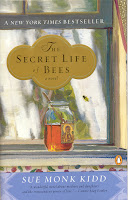
The Secret Life of Bees, by Sue Monk Kidd
This sweeping debut novel, excerpts of which have appeared in Best American Short Stories, tells the tale of a 14-year-old white girl named Lily Owen who is raised by the elderly African American Rosaleen after the accidental death of Lily's mother. Following a racial brawl in 1960s Tiburon, SC, Lily and Rosaleen find shelter in a distant town with three black bee-keeping sisters. The sisters and their close-knit community of women live within the confines of racial and gender bondage and yet have an unmistakable strength and serenity associated with the worship of a black Madonna and the healing power of honey. In a series of unforgettable events, Lily discovers the truth about her mother's past and the certainty that "the hardest thing on earth is choosing what matters." The stunning metaphors and realistic characters are so poignant that they will bring tears to your eyes. (David A. Berone, Library Journal)

The Divine Secrets of the Ya-Ya Sisterhood, by Rebecca Wells
 When Vivi and Siddalee Walker, an unforgettable mother-daughter team, get into a savage fight over a New York Times article that refers to Vivi as a 'tap-dancing child abuser,' the Ya-Yas, sashay in and conspire to bring everyone back together. In 1932, Vivi and the Ya-Yas were disqualified from a Shirley Temple Look-Alike Contest for unladylike behavior. Sixty years later, they're 'bucking 70' and still making waves. With passion and a rare gift for language, Rebecca Wells moves from present to past, unraveling Vivi's life, her enduring friendships with the Ya-Yas, and the reverberations on Siddalee. The collective power of the Ya-Yas, each of them totally individual and authentic, permeates this story of a tribe of Louisiana wild women who are impossible to tame.  (Publisher's Review)

Friday, June 11, 2010

Readers Abroad

While recently traveling in Madrid, Spain, I stumbled upon an outdoor book fair in Madrid's famous 300 acre park, Parque del Retiro (the former garden of Felipe IV). The book fair featured over 300 independent book vendors who sold everything from local authors, to those we might find in our very own libraries and book stores. In fact, there was a lot of popular American literature available (in Spanish), for children and adult readers alike. Based on what the vendors of juvenile literature were featuring, Diary Of A Wimpy Kid is just as popular with Europeans as it is here in the States.  Check out some of these photos and see if you spot anything familiar...

Create your own video slideshow at animoto.com.

Wednesday, June 2, 2010

For Mystics & Romantics

If you like Daphne Du Maurier (author of Rebecca and Jamaica Inn), you'll love Robert Goolrick's A Reliable Wife.  Like the novel Rebecca, A Reliable Wife is written in the tradition of Gothic Romance:  it features an old (haunted) house, darkness, death, revenge and lust.  Unlike Rebecca, these characteristics take on more contemporary forms:  the ghosts aren't apparitions, they're psychological; further, the romance takes on a much sexier description.  It's because of these contemporary features, which Goolrick utilizes to progress the storyline, that the novel reads in a quick, gripping fashion (I began and finished it in about 7 hours while on a flight).

The premise of the story revolves around an older single (and very wealthy) man's desire for companionship.  He thus puts an ad in the newspaper calling for "a reliable wife".  The woman who answers his ad, Catherine Land, has various motives for entering into the relationship--but none are so devious as the slow and methodical arsenic poisoning of her new husband.  The catch:  Ralph knows full well of her acts and the motives behind them.  The joy for the reader is that we do not; in fact, Goolrick leads us to the end of the novel with unexpected twists and turns that I'm not about to reveal here.  A Reliable Wife is a juicy good read, perfect for independent reading or a book club.

Friday, May 14, 2010

The Vicarious Traveler

When I was in high school and college, my mom and I would make weekly visits to our local library during my summer breaks.  While I have many reading interests, my particular focus at that time (and whenever nature hints at summer) was travel.  I'd read anything from travel guides to personal narratives--and specifically loved watching travel videos, like Rick Steves.  In fact, I've vivid memories of standing in my Davenport branch library perusing the (then small) VHS collection of video tour guides and thinking to myself, "Now where do I want to go today?"  It sounds hokey, but I still love the idea of travel--even if vicariously.  I'm perfectly content to trip to Paris by watching Samantha Brown's "Passport to Europe" (repeatedly, in fact).  (Though, I must warn you:  once you've a taste for a particular place, the videos are mere pacifiers in place of the real thing.) 

While I'm soon-to-be on vacation, I've been thinking a lot, recently, about good travel narratives.  Here are just a handful of my favorites.  (I highly recommend the first two!)

The Geography of Bliss: One Man's Search for the  Happiest Places In the World, by Eric Weiner

The Art of Travel, by Alan de Botton


As the Romans Do: An American Family's Italian Odyssey, by Alan Epstein


A Year In the Merde, by Stephen Clarke


Market Day in Provence, by Michelle De La Pradelle

Sunday, April 25, 2010

In Defense Of Food

I'll be the first to admit these two truths:  I love to eat good food and I love to read about eating good food.  No one writes about good food--it history, and how to find it, cook it, and eat it--better than Michael Pollan.  This past week, while on a road trip to a library conference, I finished listening to Pollan's In Defense of Food: An Eater's Manifesto on audio book.

Readers may be more familiar with his The Omnivore's Dilemma: A Natural History of Four Meals, or more recently his book turned PBS documentary, The Botany of Desire: A Plant's-Eye View of the World.  Similar to these two works,  In Defense of Food examines food from social, cultural and scientific perspectives.  But more specifically, in this, Pollan presents a fascinating analysis of the American diet:  how we eat, and how and why our eating habits have changed since the mid-20th century.  He balances this history by presenting a series of "rules" for eating (which he's recently condensed into his book Food Rules: An Eater's Manual).  Things like,"Eat food.  Not too much.  Mostly plants"--the line with which he opens.  To the more humorous, "Don't eat anything your grandmother wouldn't recognize as food."  It's all fairly common sense stuff--but utterly fascinating.  If nothing else, readers of Pollan's work will become more cognizant of the food they eat.  Devotees (like me) will find themselves taking a more action-oriented approach:  reading labels, planting a garden, shopping locally, eating organic, and spreading the word.   Highly recommended.

Sunday, April 11, 2010

Life On the Farm

Admittedly, I had one primary worry about our last Adult Book Club selection, Michael Perry's memoir Coop: A Year Of Poultry, Pigs and Parenting--namely, that people might not make it past the first chapter.  (I know of at least one individual who gave up before its end!)  Perry opens with a (pages long) description of the "farmer snort" method of blowing one's nose.  I'm not entirely sure why he chooses to begin in this way.  And I can see where it would be over-the-top for some readers, if not off-putting.  But those who spend a little patience on him as he develops his narrative will be rewarded in the end. 

At heart, Coop is a story about farms and families.  Perry's memoir moves back and forth between his current life with wife Anneliese, as they raise daughters Amy and new baby Jane, and his own life growing up on a farm.  My favorite section is undoubtedly Chapter 5 which describes the at-home birth of Jane.  Perry's recounting is touching, beautiful, vivid, inspiring.  But my overall impression of the work always comes back to Perry and his relationship with daughter, Amy.  Amy is present in nearly everything Perry experiences, and its her presence and free-spirit which gives awareness and meaning to the very simple pleasures of farm life which he describes.  Perry is nostalgic in these moments, but with the mark of a great writer, he never over-sentimentalizes.  A good read for anyone who's ever lived on a farm, raised a family or just has a natural curiosity. 

Wednesday, April 7, 2010

Gleeful for Glee

If there's one television show this season that I can't get enough of it's FOX's new hit, GleeGlee is the continuing story of a high school glee club, its members and the adults (in this case, a group of teachers and coaches) who anchor the whole thing.  In many ways, the show models other teen stories:  the central group of students are talented misfits who no one has much faith in, and yet, who continue to prove everyone wrong.  But that's not really what's worth watching about Glee.  The joy of the program comes from the sometimes dark, always quirky characters--the budding superstar and drama queen, Rachel; the overzealous and hilariously cruel cheerleading coach (played by Jane Lynch); the adorably obsessive-compulsive counselor--who would all drive us nuts in real life, but who we love to root for in this setting.  And let's not forget what this show is all about:  the music.  The cast is truly superb:  so much so that if you don't find yourself singing along, or at least bouncing your knee or foot, you're very much alone.  In fact, if you listen enough, you may find yourself forgetting the originals of the many popular songs the cast covers.  For example, in the last episode of Part I of this season, the lead role of Rachel, played by Lea Michele, "out Barbara Streisands Barbara Streisand" (to quote a friend of mine) in her version of "Don't Rain On My Parade" from Funny Girl.  That alone is something to see.

Part II of Glee begins next week on FOX.  In the meantime, check out Part I on DVD, or either of the two tv soundtracks, at your local library.  You'll be oh so happy you did.