Every once in awhile a book comes a long that quite literally takes my breath away. For that to happen requires the following features to coalesce: a complex or complicated subject matter (oversimplification isn't interesting to me); dynamic characters (who often struggle with the complex or complicated subject matter); a new lens through which to examine a moment in time; believability; good writing. For me, this includes Tim O'Brien's The Things They Carried; Toni Morrison's Beloved; Jhumpa Lahiri's Interpreter of Maladies, to name a few. And now, The Lotus Eaters, by Tatjana Soli.
Like Tim O'Brien, The Lotus Eaters is a haunting story about the Vietnam War. The twist is this: our protagonist is an American female photo-journalist who falls in love with a ruined country, and like many of the journalists and soldiers who precede her, becomes addicted to its war. What's particularly lovely about the work are the many nuances Soli effortlessly incorporates: the extended metaphor of Homer's Odyssey, or the ever-present Vietnam landscape, for example. Soli brings the Vietnam War to life--rewarding readers in unforgettable ways. Highly recommended.
Check out the author's website
http://www.tatjanasoli.com/TatjanaSoliAuthor.html
Thursday, March 17, 2011
Thursday, February 17, 2011
More "Living Locally" Blogs
For further viewing and reading on living locally, check out these blogs, recommended in the most current edition of Radish Magazine:
Crosswinds Farm
Brazy Creek Farm
Antiquity Oaks
Farm Genevieve
Front Porch Indiana
Crosswinds Farm
Brazy Creek Farm
Antiquity Oaks
Farm Genevieve
Front Porch Indiana
Living Locally
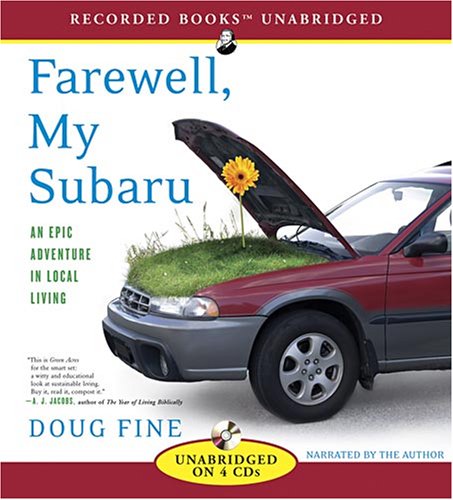
Sometimes the best read is the one that I have no expectations about. Such is the case with an audio-book I found while mindlessly browsing the shelves at Davenport Public Library entitled Farewell, My Subaru, by Doug Fine.
Fine (humorously) tells the story of his settling in the Southwest with the sole purpose of living locally. So, he purchases his ranch, along with two goats, a coop-full of chickens--and yes, forsakes his beloved Subaru for a car which runs entirely on bio-diesel fuel (which he feeds, by the way, with grease from local eateries). We learn of his missteps and adventures along the way: managing his mischievous, child-like goats; or, protecting his chickens from preying coyote. As rustic as the whole experience sounds, it's also appealing to the adventurous of heart, and of course, to anyone who tries (even in the smallest of ways) to live locally.
Worth listening to, then check out Doug Fine's "living locally" blog.
Fine (humorously) tells the story of his settling in the Southwest with the sole purpose of living locally. So, he purchases his ranch, along with two goats, a coop-full of chickens--and yes, forsakes his beloved Subaru for a car which runs entirely on bio-diesel fuel (which he feeds, by the way, with grease from local eateries). We learn of his missteps and adventures along the way: managing his mischievous, child-like goats; or, protecting his chickens from preying coyote. As rustic as the whole experience sounds, it's also appealing to the adventurous of heart, and of course, to anyone who tries (even in the smallest of ways) to live locally.
Worth listening to, then check out Doug Fine's "living locally" blog.
Thursday, February 10, 2011
Revisiting Betty Friedan
I caught wind of Stephanie Coontz's new book, A Strange Stirring: The Feminine Mystique and American Women at the Dawn of the 1960s, while listening to a recent episode of NPR's Fresh Air with Terry Gross. My ears perked immediately: I've long been a fan of Coontz's theses, which include The Way We Never Were: American Families and the Nostalgia Trap (1992) and Marriage: A History: How Love Conquered Marriage (2006). I love both. So, I didn't wait to order a copy of her new work, which was inspired, she tells Gross, when her publisher asked her to write a biography of Betty Friedan's controversial feminist work, The Feminine Mystique. I've not been disappointed. Coontz provides first-hand accounts of women who recall their reaction to reading Friedan's work when it was first published in 1963. But she goes a step further to draw connections between the dissatisfaction of our mothers and grandmothers, to the social pressures of women and young girls today. And, while she applauds the relief Friedan brought to many housewives of the 1960s, she recognizes that her work excluded many other sectors of women, including the working class and ethnic minorities. The combination of perspectives makes for an engrossing work.
Wednesday, January 12, 2011
Best Books of 2010
In case you missed a good read last year, here are some well-respected lists of the best of 2010, including fiction and non-fiction:
Publisher's Weekly
National Public Radio (NPR)
New York Times
Barnes & Noble
Publisher's Weekly
National Public Radio (NPR)
New York Times
Barnes & Noble
A Real, Readable Mystery
The Scent of Rain and Lightning is a readable, subtle mystery-drama. It begins with protagonist, Jody Linder, as she learns that the man sentenced for murdering her parents has been released from prison. The narrative then unfolds, as we are taken back in time to Jody's childhood and what came before and after her parents' death. As Pickard moves effortlessly between past and present, we begin to understand the family dynamic, and a budding, yet forbidden, relationship between Jody and the son of the accused murder. Like a good mystery should, the novel holds us until the very unpredictable end, when the evening of the murder is fully revealed. What is further enjoyable is the recognizable mid-western landscape, and the way in which Pickard utilizes the landscape in combination with the acts of mother nature to create a larger metaphor.
The Scent of Rain and Lightning follows Pickard's well-reviewed The Virgin of Small Plains.
Tuesday, December 7, 2010
For Optimists & Skeptics Alike
I have to admit: I wasn't the huge fan of Elizabeth Gilbert's now famous Eat, Pray, Love: One Woman's Search For Everything Across Italy, India and Indonesia that almost every other American woman my age seemed to be. Yes, I enjoyed the mind's travel; yes, the vicarious romances. But I always ended up setting the book down because Gilbert's tone seemed to me, well, whiny. And this is why I avoided, for a long time, her newest book, Committed: A Skeptic Makes Peace With Marriage. But unlike her first best-seller, Committed relays a mature voice that I found myself clinging to.
Narratively, Committed picks up where Eat, Pray, Love leaves off. She and Philippe are together, (somewhat) settled, and living in happy agreement that they will never marry, despite their love for one another. But this all changes when Homeland Security discovers that Philippe has overstayed his welcome in America, and must acquire a permanent visa to reenter. Of course, the Homeland Security Officer tells them that the only likely way for Philippe to do this is to marry his American born love. From this beginning, Gilbert takes readers through a story that is part memoir, part history, part anthropological study, and yes, part travel narrative. She and Philippe continue their travels, not because they want to this time, but because they must. In the meantime, Gilbert feverishly researches marriage from the culture at large, and delves into an analysis of her own parents' marriage, all while trying to secure a life with Philippe and do the thing that both of them swore they would never do: marry. Highly recommended for anyone who's ever married, divorced, or contemplated either.
Thursday, November 4, 2010
Not So Magical
Anyone interested in Puritain-American history, or the Salem Witch Trials, would appreciate Katherine Howe's The Physick Book of Deliverance Dane. In it, PhD student, Connie, is supposed to be working on her dissertation proposal over the summer when her mother asks her to clean up her deceased grandmother's abandoned house. As she begins, she discovers the name, Deliverance Dane, and a secret key--all of which leads to a book-length investigation in search for the identity of Deliverance Dane, and her so-called "physick book". Howe moves between past and present: Connie's present-day search and the historical setting of Salem, Mass during the 17th century. The latter is most interesting, as we learn a variety of new and insightful details about the Witch-trials. And while the overall work is entertaining, it possesses too many flaws (flat characters, hokey magic and cliched romance) to be as scary as I had hoped it to be.
Tuesday, October 12, 2010
Calling All Book Lovers
Did you know that October is National Reading Club Month? If you're not already part of a Book Club--Oprah's, your local library's or your own--now is never a better time to join. A reading group is a great way to meet new people, engage in meaningful conversation and enjoy some truly excellent stories.
Julia Hull District Library has several club options for readers, including an Adult Book Club, Short & Sweets (short story discussion group) and Great Reads series. If you'd prefer to gather with close friends to chat about books of your own choosing, remember that your local library can loan copies of books and book club kits for free to library card holders!
This year's National Reading Club Month's selections and descriptions may be found at the following link: http://www.nationalreadinggroupmonth.org/ggr_selections.html . *Note: Chris Cleave's Little Bee was Julia Hull Library's Adult Book Club pick for August 2010.
Julia Hull District Library has several club options for readers, including an Adult Book Club, Short & Sweets (short story discussion group) and Great Reads series. If you'd prefer to gather with close friends to chat about books of your own choosing, remember that your local library can loan copies of books and book club kits for free to library card holders!
This year's National Reading Club Month's selections and descriptions may be found at the following link: http://www.nationalreadinggroupmonth.org/ggr_selections.html . *Note: Chris Cleave's Little Bee was Julia Hull Library's Adult Book Club pick for August 2010.
Thursday, September 30, 2010
More Gladwell
Blink: The Power of Thinking Without Thinking, an admirable follow-up to Malcolm Gladwell's The Tipping Point (see August 24 entry), is an engaging analysis of human cognition. In Blink, Gladwell presents the idea of "thin-slicers"--that is, individuals who make instantaneous judgments and decisions about other people and situations. He provides numerous examples to demonstrate how this sort of decision making is often more intuitive and more accurate than that which which has been researched and analyzed. For example, he presents the story of a fake Kouros (an ancient Greek sculpture) which deceived one team of art experts who'd spent months studying it; or a psychologist who can determine with 95% accuracy whether a married couple will divorce simply by watching an hour-long video of them engaging in conversation. The engrossing examples go on and on--some of them demonstrating the positive power of thin-slicing, while others demonstrate its potential flaws. As usual, Gladwell flawlessly connects all of these examples to build a clear argument that's socially and culturally relevant.
Subscribe to:
Posts (Atom)